Prove the business case
didn’t stop at approval.
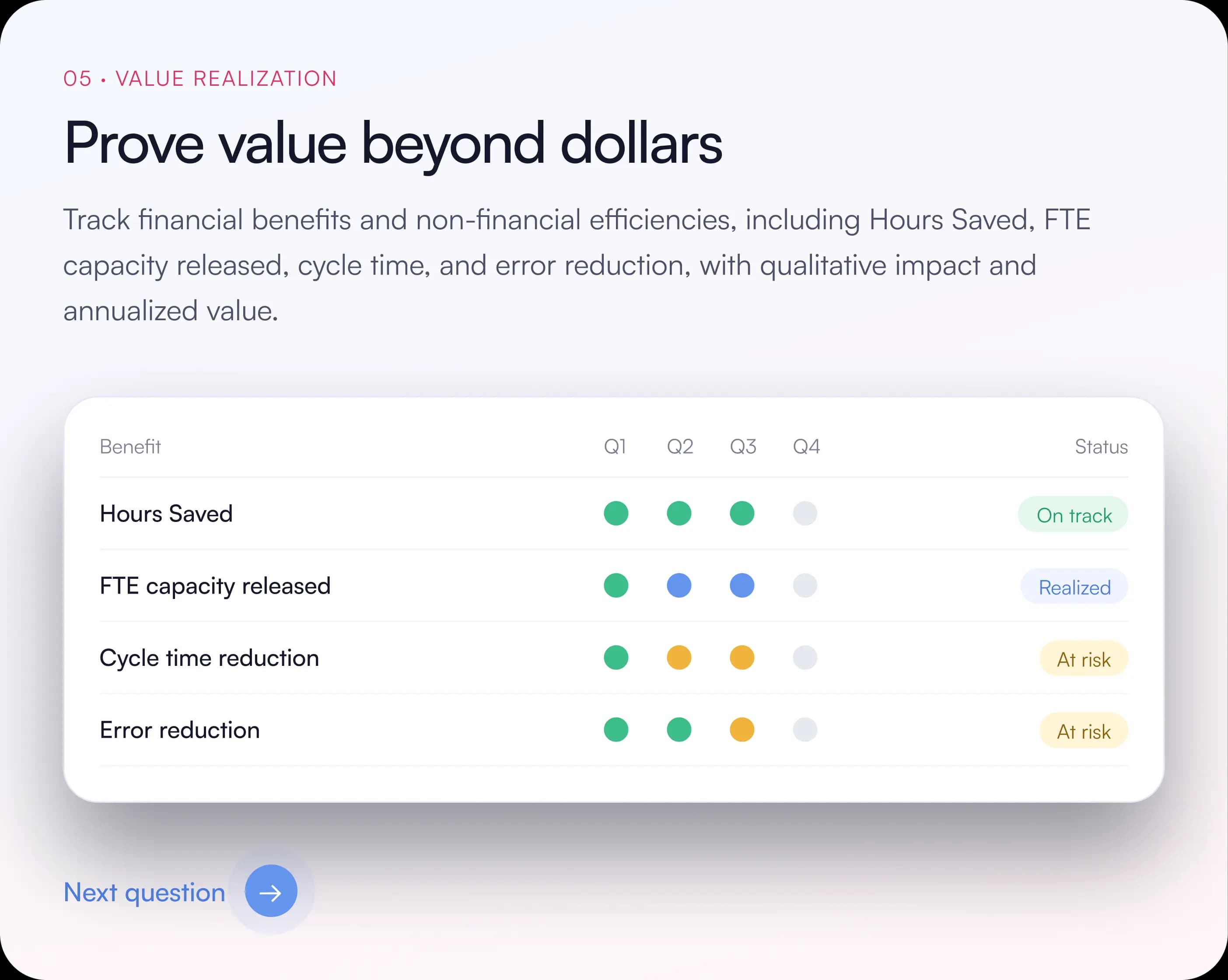
Value Tracker shows what was actually delivered, including financial returns and non-financial efficiencies like Hours Saved, with actuals pulled directly from your ERP and a latest summary generated by AI, so you walk into steering with the answer, not a spreadsheet.
No credit card required · SOC 2 Type II · Connects to Model Builder

3
definitions — estimate, budget, actual — reconciled on one line
EAC
calculated on standard EVM logic, not re-derived from the original ask
100%
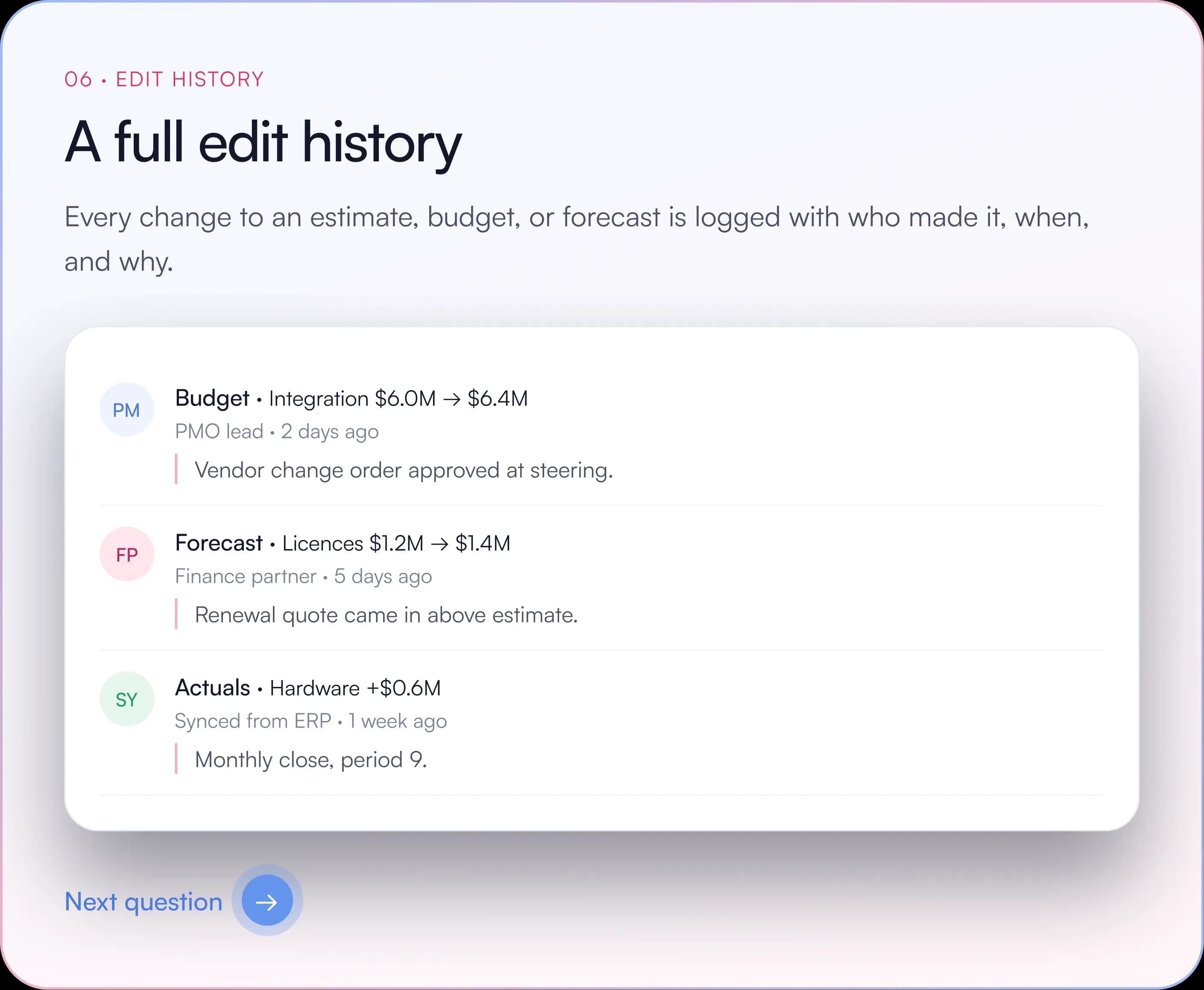
of edits to any figure logged with who, when, and why
1
bridge chart, always current, ready for the steering deck
Approval day
Projects get approved on assumptions.
Once approved, the estimate becomes a budget. That is the number the case is now held to.
EAC over time · Network modernization
Week 1 · EAC $18.4M
Everything a business case needs after approval
Every case produces the same questions eventually. Value Tracker is built to keep answering them, long after the approval meeting. Pick a question.
01 · Reconciliation
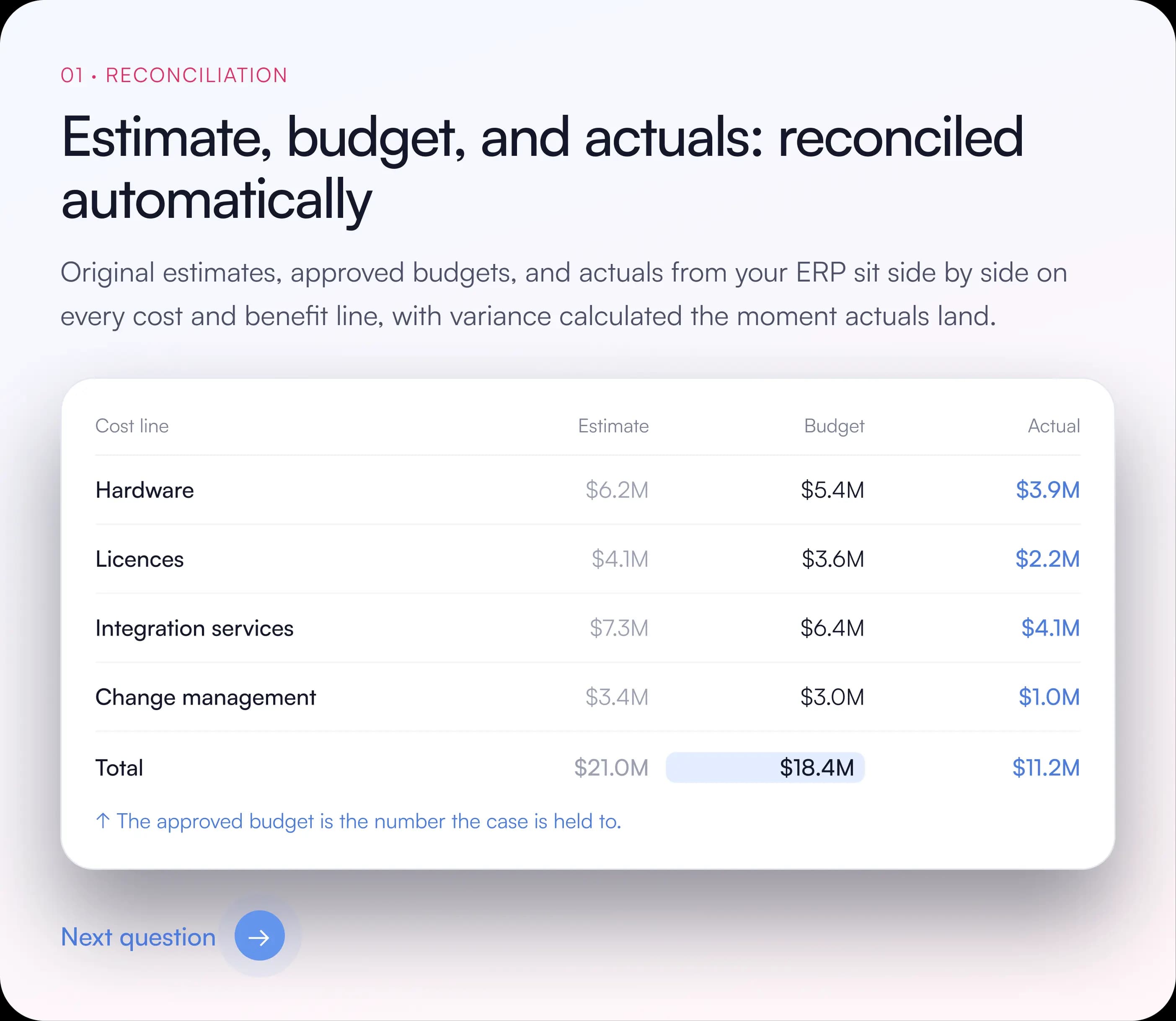
Estimate, budget, and actuals: reconciled automatically
Original estimates, approved budgets, and actuals from your ERP sit side by side on every cost and benefit line, with variance calculated the moment actuals land.
01 — Hard savings. Type 1
Track every dollar your project was supposed to save.
Type 1 captures pure financial impact. On the cost side, track estimated, budgeted, and actual spend together so you can see exactly where capital is going against what was approved.
02 — Soft savings. Type 2
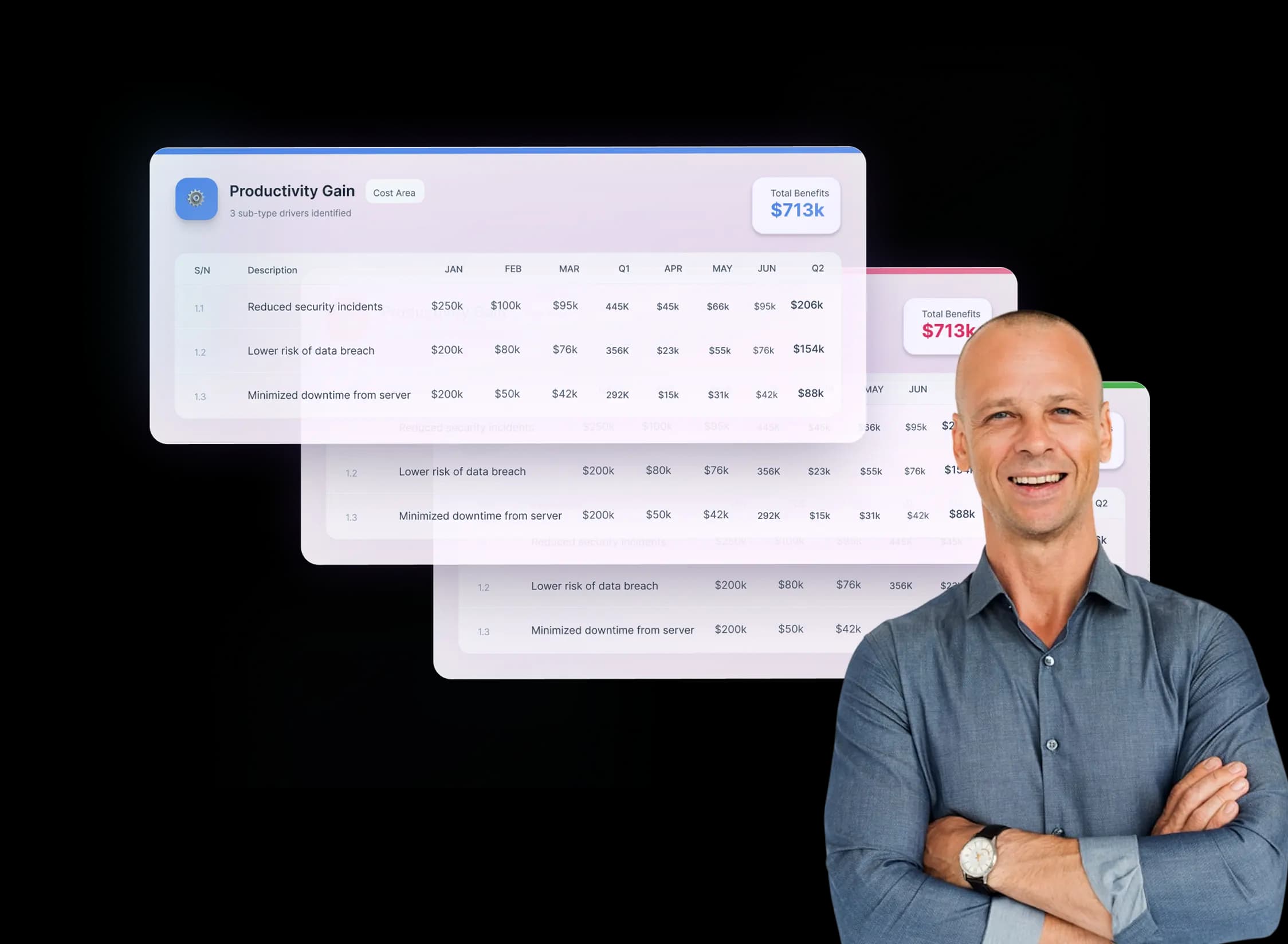
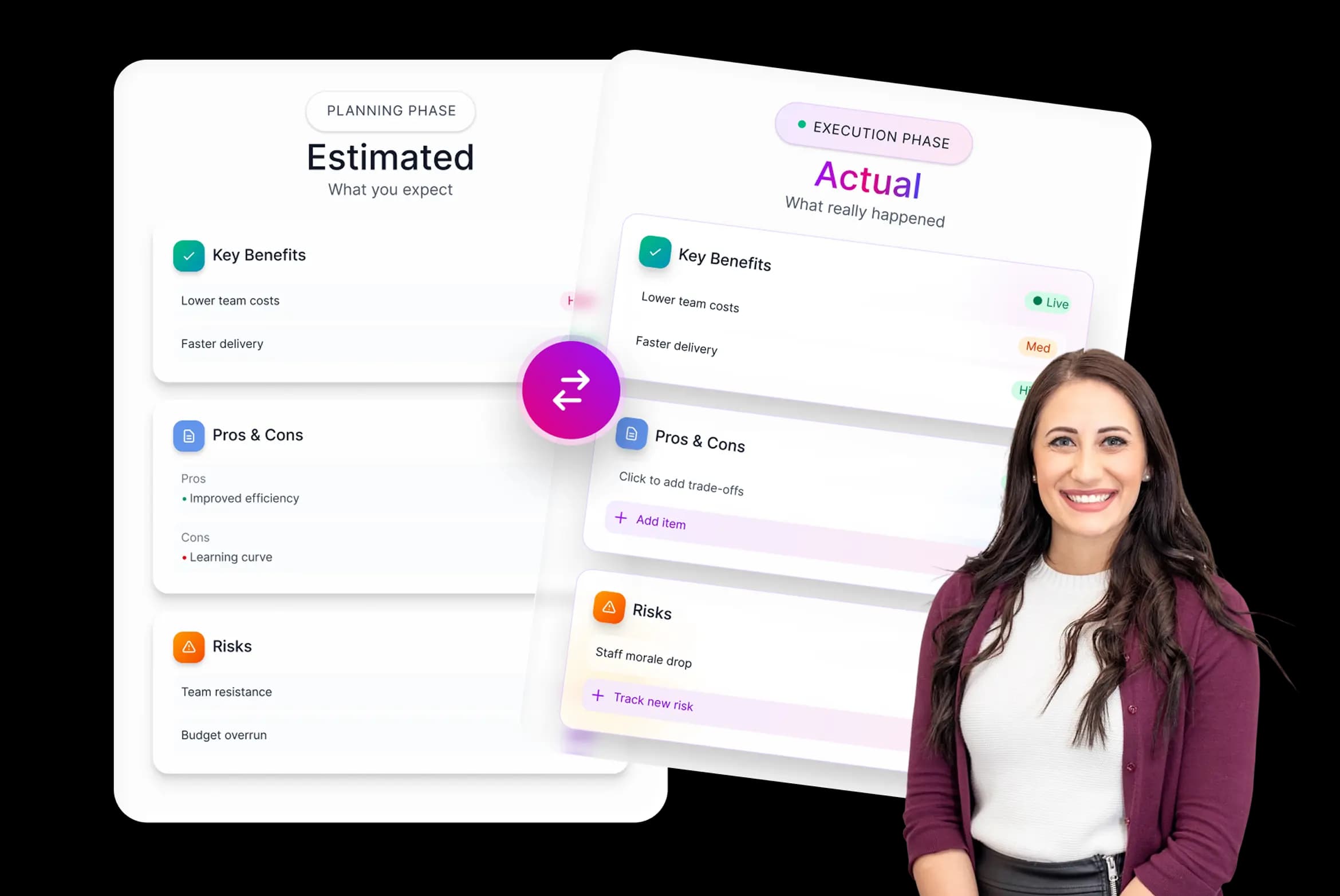
Productivity gains are real value. Now you can prove it.
Type 2 captures efficiency and productivity improvements that don’t show up as direct cost reductions but represent genuine organizational value.
03 — Qualitative outcomes. Type 3
The outcomes that matter most now have a place
Not every benefit is a number. Improved employee experience, stronger vendor relationships, reduced regulatory risk. These are real outcomes that influence strategic decisions. Type 3 gives qualitative commitments the same structured home as financial ones.
04 — Variance tracking
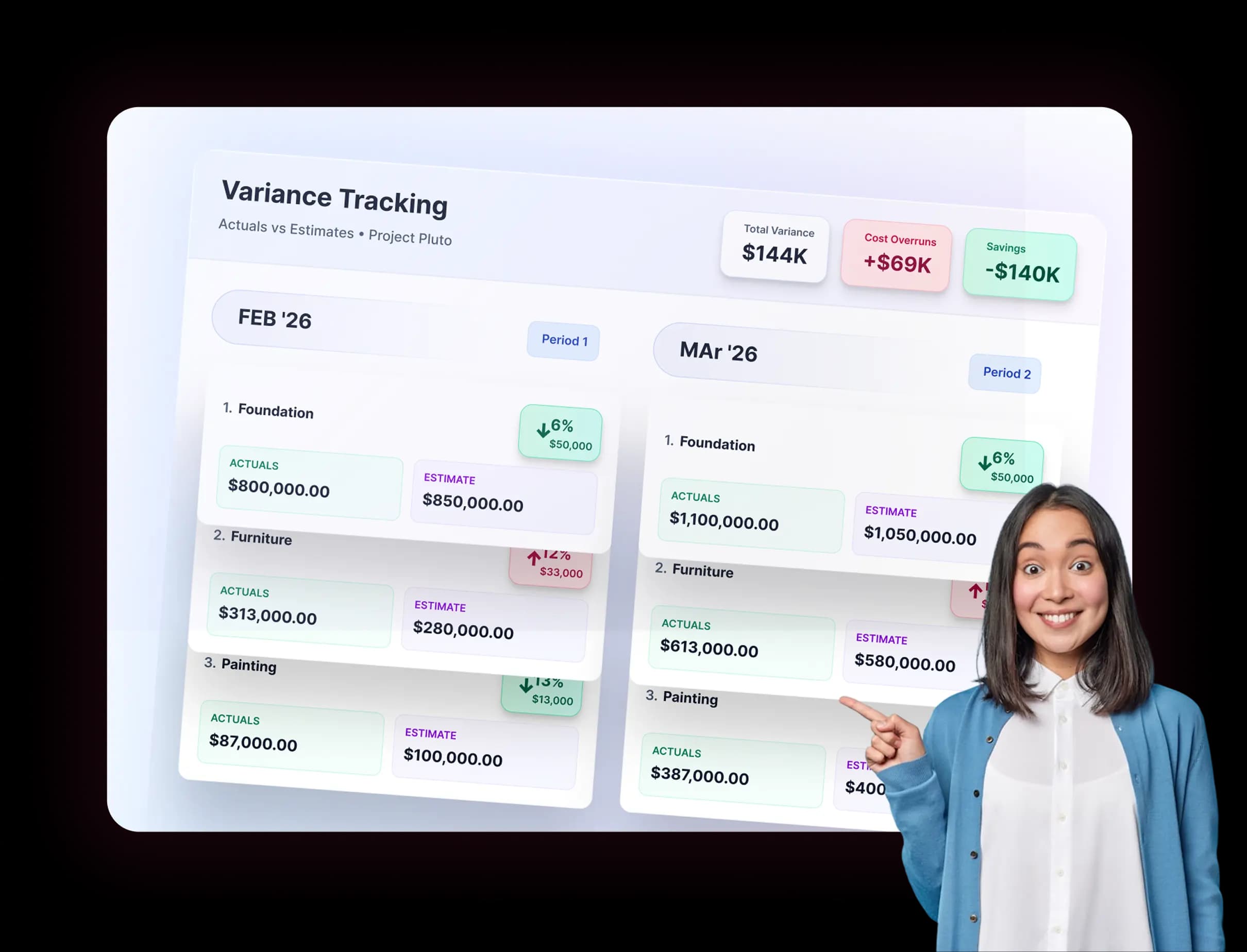
See gaps before your projects grow in dollars and in percentage.
Access variance by both currency and percentage across every tracked line so you can see not just that something is off, but how significant the drift is relative to the original commitment. Catch a 5% variance while it’s still recoverable. Don’t wait for a 40% miss to show up in a quarterly review.
05 — Value dashboard
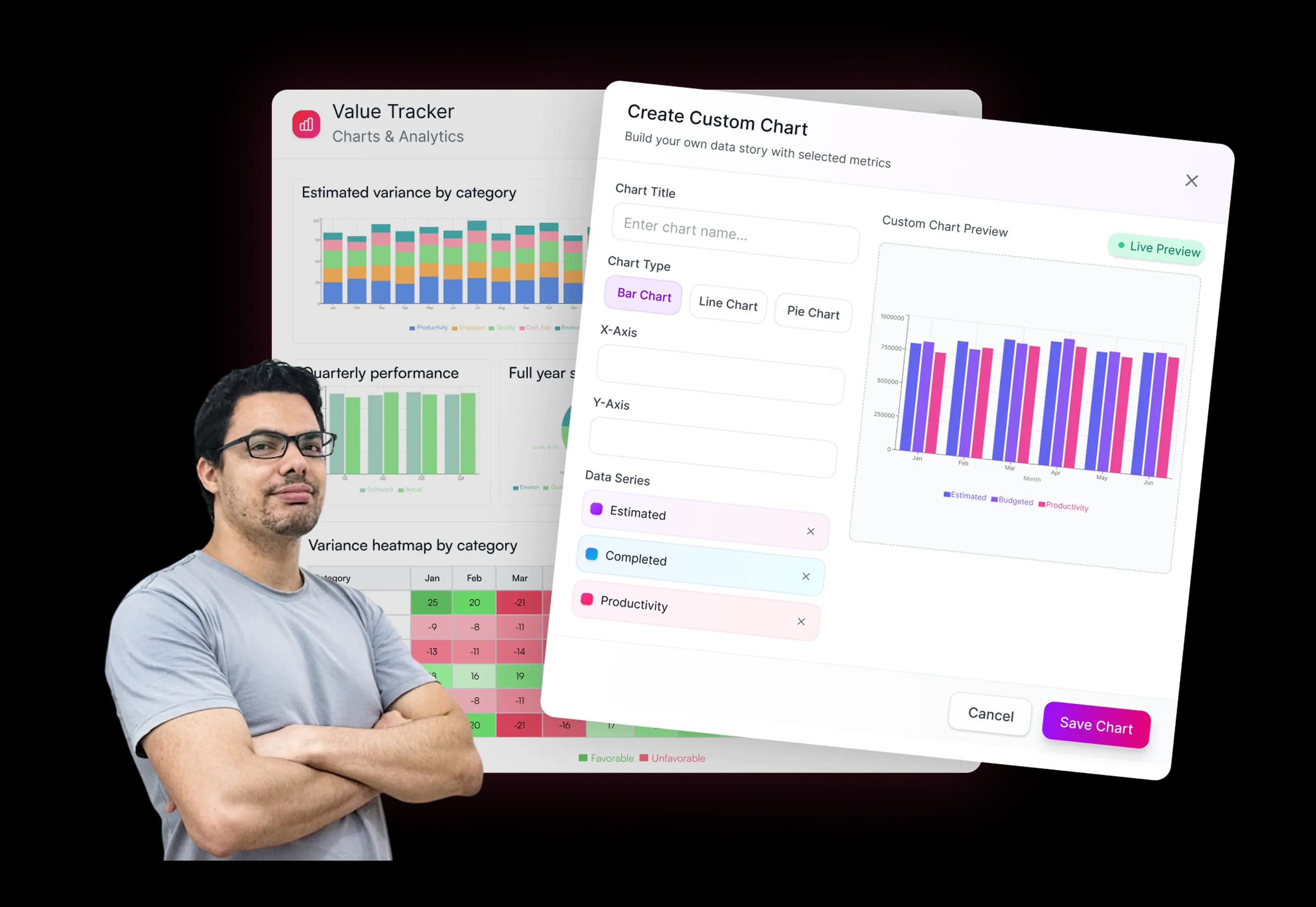
One view of what every project in your portfolio is actually delivering.
Aggregates hard savings, soft savings, and qualitative outcomes across all tracked projects into a single executive-ready view. See which projects are performing, which are drifting, and where burn rate signals trouble ahead, without pulling a single report or chasing a single status update.
01 — Hard savings. Type 1
Track every dollar your project was supposed to save.
Type 1 captures pure financial impact. On the cost side, track estimated, budgeted, and actual spend together so you can see exactly where capital is going against what was approved.
How a case moves through the tracker
The same four stages, whether it’s a small enhancement or a multi-year program.
Estimate
$21.0M
- 01
Build the case
Model estimated costs and benefits, with assumptions attached to each line.
- 02
Get it approved
Once approved, the estimate becomes a budget. That is the number the case is now held to.
- 03
Track actuals from your ERP
Actuals are extracted directly from SAP, Oracle, Workday, or Dynamics and reconciled against budget, so you stop chasing month-end close.
- 04
Prove what was delivered
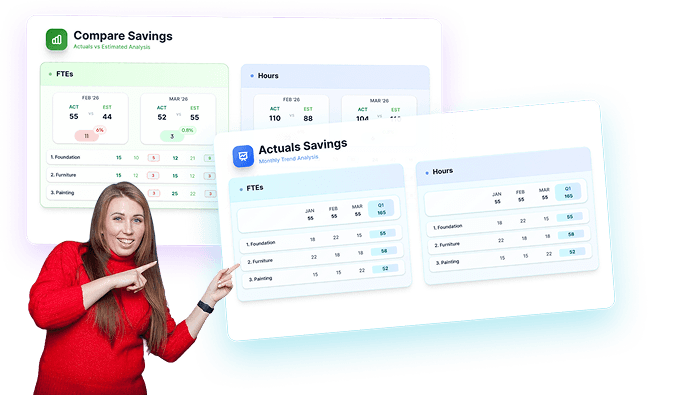
Financial value and non-financial efficiencies, including Hours Saved, FTE, and cycle time, roll up to Value Realized YTD. Generate the latest summary with AI when you need it.
Built for the people who get asked to explain the number
A PMO, a finance partner, and a sponsor rarely want the same view of the same case.
One place to run the case
Maintain the case, update actuals, and show governance exactly where a project stands — without rebuilding a deck from scratch each cycle.
- Audit trail on every change to budget or forecast
- AI-drafted status summaries between reviews
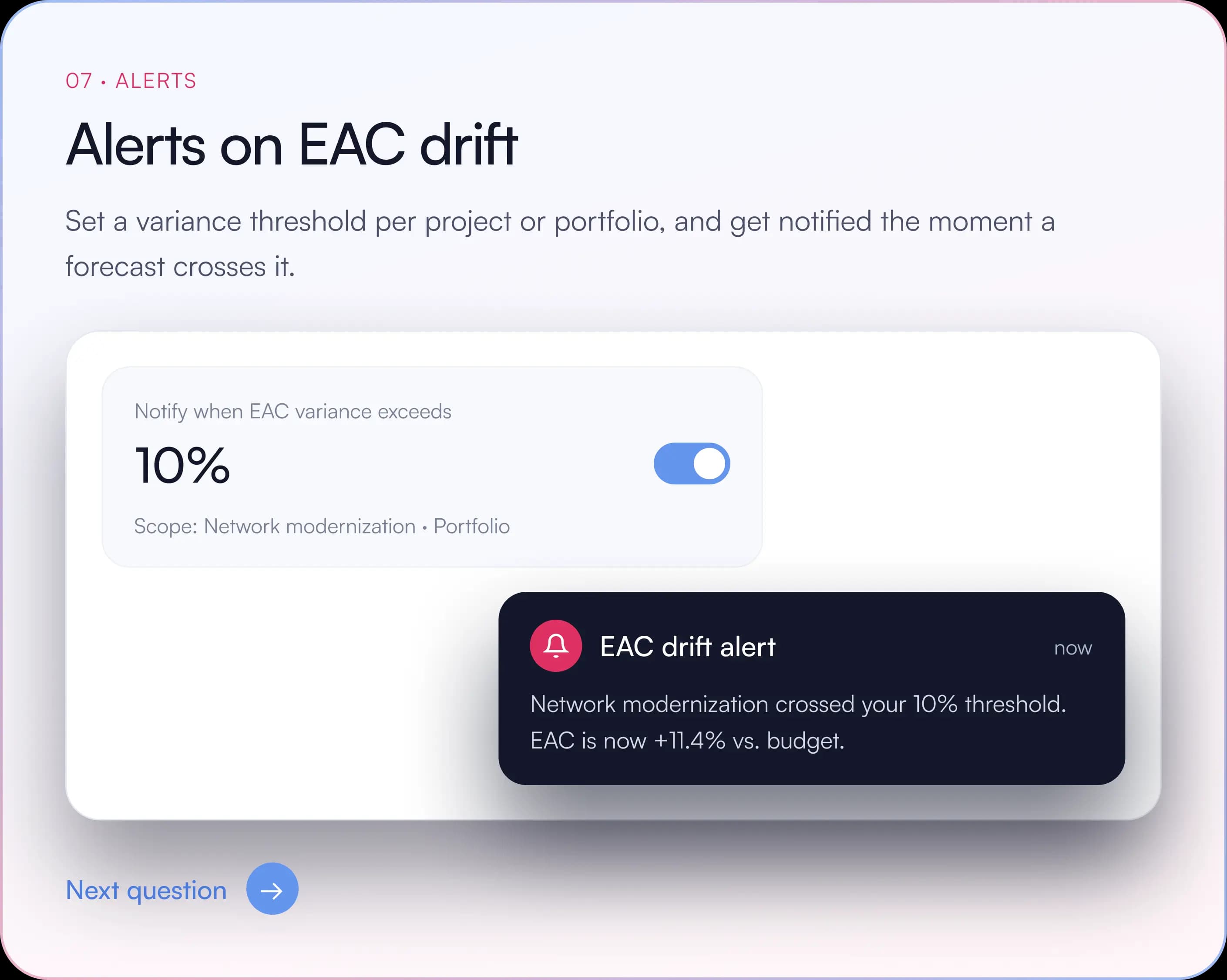
- Threshold alerts before the steering meeting, not during it
Consistent definitions, every case
Budget, actuals, and EAC calculated the same way across every business case, so a forecast means the same thing portfolio-wide.
- EAC computed on standard EVM logic
- Cost and benefit variance tracked side by side
- Exportable detail for close and board reporting
One view of what changed, and why
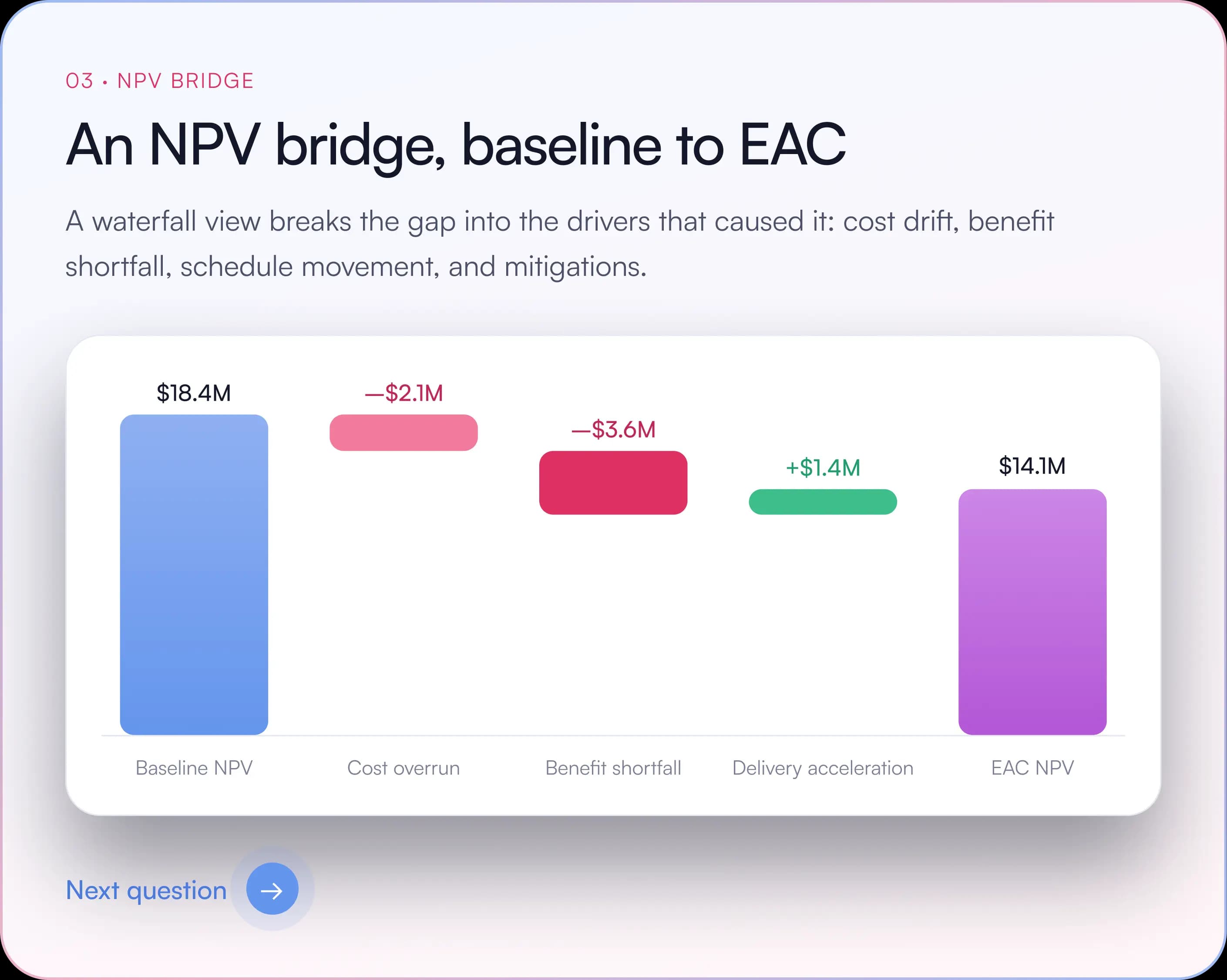
A bridge that explains the gap between what was promised and what’s now forecast — without a pre-read.
- Baseline-to-EAC NPV bridge, always current
- Benefit realization status over time, not a single snapshot
- A narrative summary instead of a spreadsheet
Platform handoff
Actuals come from your ERP, not a spreadsheet.
Once a model is approved, it becomes the budget baseline in Value Tracker. Actuals flow from your ERP, efficiencies are tracked as first-class records, and the latest summary is ready when steering asks.
Model Builder
Approved
Value Tracker
Budget baseline

See what value tracker is delivering for finance leaders.
We caught a $2.3M projected overrun 6 weeks early because of the variance tracking. That's the kind of early warning no spreadsheet has ever given us.

Matthew Collins
VP of Finance, Enterprise Professional Services
For the first time, our CFO can see not just whether we're on budget, but whether the project is actually delivering the productivity gains we promised.

Daniel Roberts
Portfolio Director, Global Healthcare Organization
No. It picks up once a case has estimated costs and benefits, and carries it through budget, actuals, EAC, and benefit realization in one connected record.
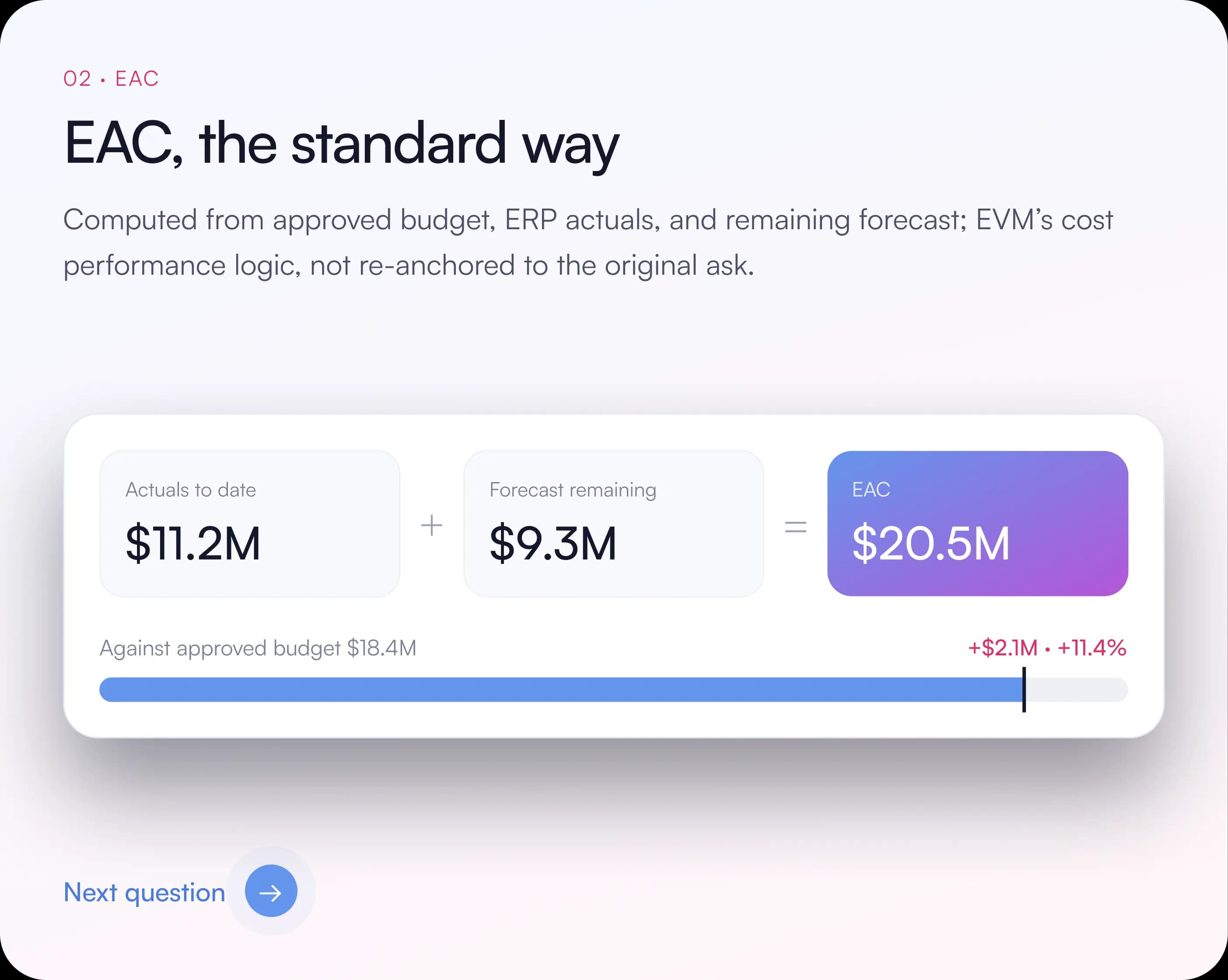
EAC is actuals to date from your ERP plus the remaining forecast, measured against the approved budget using standard earned value cost-performance logic. It is never re-anchored to the original estimate.
AI drafts the latest summary: what changed, value realized across financial returns and efficiencies, risks, and what needs a decision. It is grounded only in that case’s data — estimates, budgets, actuals, efficiencies, and edit history.
Yes. Actuals are extracted directly from SAP, Oracle, Workday, or Dynamics and reconciled against budget on every cost line, so variance updates as each period closes.
Questions worth asking before you roll this out
Still have questions?
Can’t find the answer you are looking for? Kindly check our complete list of FAQs.
View Complete FAQsStop presenting the business case. Start showing what it’s actually doing.
We’ll walk through the module against one of your own cases: estimate, budget, ERP actuals, financial and non-financial value, and the bridge, live.
No credit card required · SOC 2 Type II · Connects to Model Builder
Stay ahead of the curve
Subscribe to our newsletter to receive valuable insights directly in your email.
Solutions


